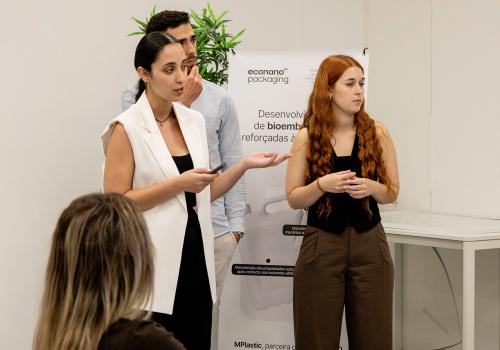
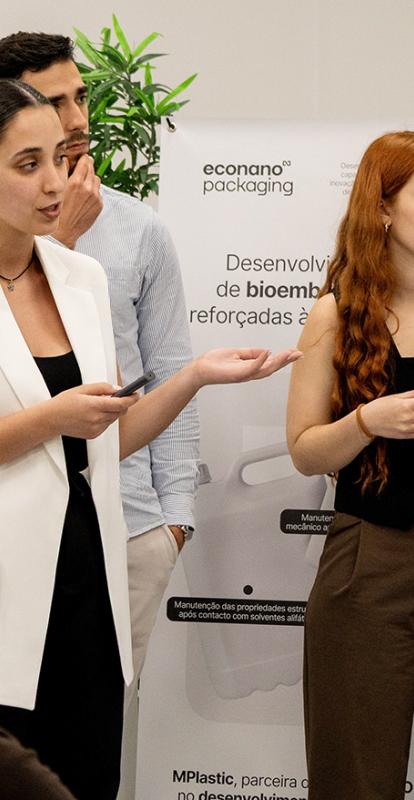
Fibrenamics participated in the Open Day of the EconanoPackaging project, held at the facilities of MPlastic, a company of the MSTN Group specialized in biomaterials and packaging. The initiative provided an opportunity to present the main developments and results achieved within the project, highlighting the importance of collaboration between R&D entities and industrial companies in the development of more sustainable, functional packaging solutions aligned with the principles of circularity.
Within the consortium, Fibrenamics and B4Logic joined the project as partners of MPlastic, contributing to the development of new formulations of functionalized polymeric compounds using natural endogenous raw materials from the Central Region of Portugal. This approach made it possible to explore more sustainable alternatives for the production of bio-based packaging through extrusion blow moulding, while maintaining a focus on technical performance, industrial feasibility and reduced environmental impact.
In collaboration with B4Logic, Fibrenamics participated in the development and optimization of formulations that demonstrated relevant improvements in mechanical performance and barrier properties. The solutions developed also maintained a reduced environmental impact, validated through life cycle assessment, reinforcing the potential of these new solutions to respond to the growing demands of the packaging sector.


Two promising formulations were also developed, showing good performance after UV exposure and chemical compatibility with aliphatic solvents. These solutions demonstrated potential for ADR certification, with approval in 75% of the tests, while reducing climate impact by up to 25% and the use of fossil resources by up to 57%.
EconanoPackaging is a clear example of the role of Fibrenamics’ applied research in developing technological solutions capable of responding to the environmental and industrial challenges of the packaging sector. A project that clearly demonstrates that innovation, the valorization of local natural resources, and collaboration between scientific and industrial partners are key to accelerating the transition towards more sustainable, competitive and circular packaging.